I think every American student should know what happened there. In fact, any student who wants to live free should know what those men did on those beaches.
When the British abandoned their stronghold at Dunkirk in 1940, many thought the war was lost. But the Allies would return. They would return four years later in numbers that are truly staggering to my mind, even today.
My grandfather fought with Patton as part of the Third Army. My great uncle was his personal dentist. I share this often, but I couldn’t be more proud of both. But they didn’t come ashore at Normandy until early July. Their story gets going later as they were part of the units who tore through France and raced into Germany. But they never would have made it to the beach if brave young men hadn’t taken that foothold prior.
I know many of you have seen Saving Private Ryan. Never forget those beaches were real. The men who fought to take them were steely eyed, bad a**es. The door to their Higgins boats dropped as bullets careened through the cavern of the vessel. Some never made it off the boat. Those who drug their gear to the beach landed on places with code names of Utah, Sword, Omaha, Gold, and Juneau.
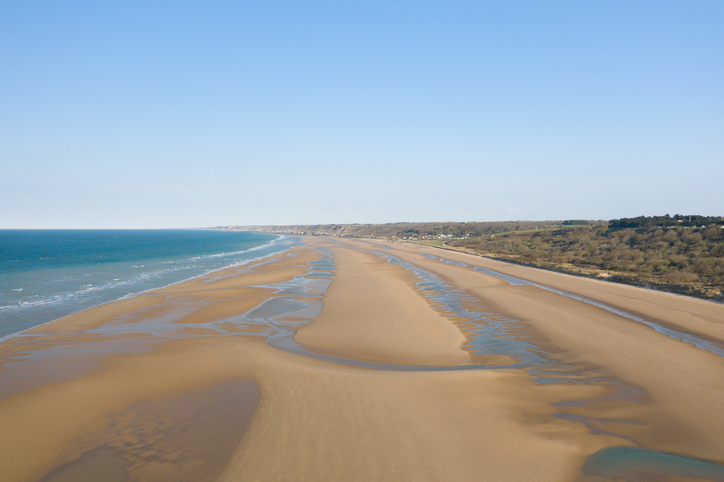
Omaha was the deadliest. 2,400-3,000 men were wounded or killed on that beach alone. The beach had not been cratered as expected by naval and air power. They had no cover. It was a life and death race across the sand. There was talk of closing that beach head during the battle. Waves of failed advances left bodies of brave men on the beach, and families back home – broken. But in the face of withering German fire, our men took that beach. With sheer determination, they straight-up just took it.
160,000 men would land on the beaches on the on June 6th, 1944. 10,000 would die, be wounded, or go missing that day. 850,000 would cross the English Channel by the end of June.
May we take a lesson from that sacred place. Sometimes bravery and courage is all that we have. They didn’t put on chicken suits and show up at No Kings rallies. No, they faced down freaking Adolph Hitler’s troops and pushed them all the way back to Berlin. Many of them were teenagers or men in their early twenties. Their lives had barely begun. They carried the torch of liberty onto that sand.
Some never came home. Some came home as just shells of themselves. The ones who survived would reshape this world when they came back home. America was never better. They new how to defend civilization. Now, they had to rebuild it.
“free.” On the edge of town, Fitzgerald saw a sight “that has never left my memory. It was a picture story of the death of one 82nd Airborne trooper. He had occupied a German foxhole and made it his personal Alamo. In a half circle around the hole lay the bodies of nine German soldiers. The body closest to the hole was only three feet away, a potato masher [grenade] in its fist.II The other distorted forms lay where they had fallen, testimony to the ferocity of the fight. His ammunition bandoliers were still on his shoulders, empty of M-1 clips. Cartridge cases littered the ground. His rifle stock was broken in two. He had fought alone and, like many others that night, he had died alone. “I looked at his dog tags. The name read Martin V. Hersh. I wrote the name down in a small prayer book I carried, hoping someday I would meet someone who knew him. I never did.”34”
― Stephen E. Ambrose, D-Day: June 6, 1944: The Climactic Battle of World War II
By dang, I am not giving it up this country without a fight, and don’t you either. Now, that is not a call to violence, and anyone who reads this blog should know better. But may we never be counted with those limp noodles who surrender our way of life too easily.
We have precedent to uphold. May our lives give their sacrifice continued purpose.
(Licensed photo of Omaha Beach by florent Martin.)
Discover more from Rob's Innovation in Education Blog
Subscribe to get the latest posts sent to your email.