

From my youngest days, I always wanted to be an architect. I let someone talk me into engineering school while in high school. No offense to my engineering friends, but it is one of the great regrets of my life. At heart I am a writer, an artist, and a mathematician. As fate would have it, I became a teacher.
I thought maybe that I would share some interesting units that I implemented over the years, and managed to still weave into the state curriculum. These are units which should require students to explore, think, and leave inspired. Technically speaking, they are integrated thematic units of study.
I get bored easily as a student. Unless you are very good at what you do or are teaching an interesting subject, my mind zones out after 30 minutes of lecture based teaching. I am a hands on learner, and I don’t like group projects. I am just one of those folks who works better alone. And you know what? That is ok. Today’s modern day education collaborations suck the life out of me. Literally, I think I have lost years off my life in education meetings. I also think it is a good thing for students to learn to think for themselves.
When I choose units of study, I want those units of study to be interesting. I try to ask myself, “If I was a kid sitting in that seat, would I find it interesting, engaging, and worth my time? Would I be more intelligent and wiser once the unit is completed?”
Looping back to architecture, our job as educators is to expand the horizons of our students. And no, I am not talking about social justice issues – I stayed far, far away from those divisive topics as a teacher. When I talk about expanding horizons, I am talking about art, music, travel, rich literature, European history, space exploration, computer weather modeling, robotics, and writing for enjoyment to name a few.
Frank Lloyd Wright is one of the best architects that the United States has every produced. In my FLW unit of study, my students were given different buildings to research, write about, and then present those projects to the class. Remember, publishing(or presentations) reaches the very top of Bloom’s Taxonomy. Ideally, students would be given the choice to work independently or as a group. All work would be graded by rubrics which would be distributed prior to the unit beginning. Students would also get to choose which architectural building they would get to research. Most units like this take 7-10 school days to complete – don’t rush good projects. Here are a few of the buildings that we researched:
Annunciation Greek Orthodox Church
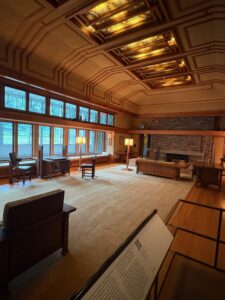
During one of my last mornings of our recent trip to New York City, I got up early and took my morning jog to the Guggenheim Museum. I took my usual path through Central Park, and dipped right just before The Met(where there is also a great FLW exhibit by the way…reference image below). There it was. It was smaller than I thought, but its design was still modern even though built in 1959 and designed over a decade earlier than that. It was one of Wright’s last works – arguably his last. It still functions as one of the world’s top museums, and the structure itself also serves as a masterpiece of art in and of itself. The Guggenheim houses works by Kandinsky, Picasso, Pissaro, Renoir, and Pollack to name a few.
ProTip: I also put together a unit about the world’s skyscrapers. It might be the best unit I ever designed.
Discover more from Rob's Innovation in Education Blog
Subscribe to get the latest posts sent to your email.